
Basic understanding of the foot.
Foot bones are connected to ankle bones and the rest of the body.

We all know where our foot is located, maybe you become more aware of it when you step on a toy or something left on the floor. We might also be aware when we are walking down the street and trip on the curb or crack from the roots of the tree that provides us shade.
Some times we forget about certain parts of our feet like the outer arch or inner arch or the base of the toe area of the feet. Try standing and see what part of your feet you feel the most. When doing this just stand do not move from side to side. When you feel you might have a good sense of this try finding other parts of your feet. For some it might be the heels and for other it might be the toes that they feel. You can use your child’s Lego to help you find other parts of your feet. Just gently step on it not like you are walking around in the dark. Feel the sensation and remember how that part feels. So when you are standing see if you can still feel that part of your foot.
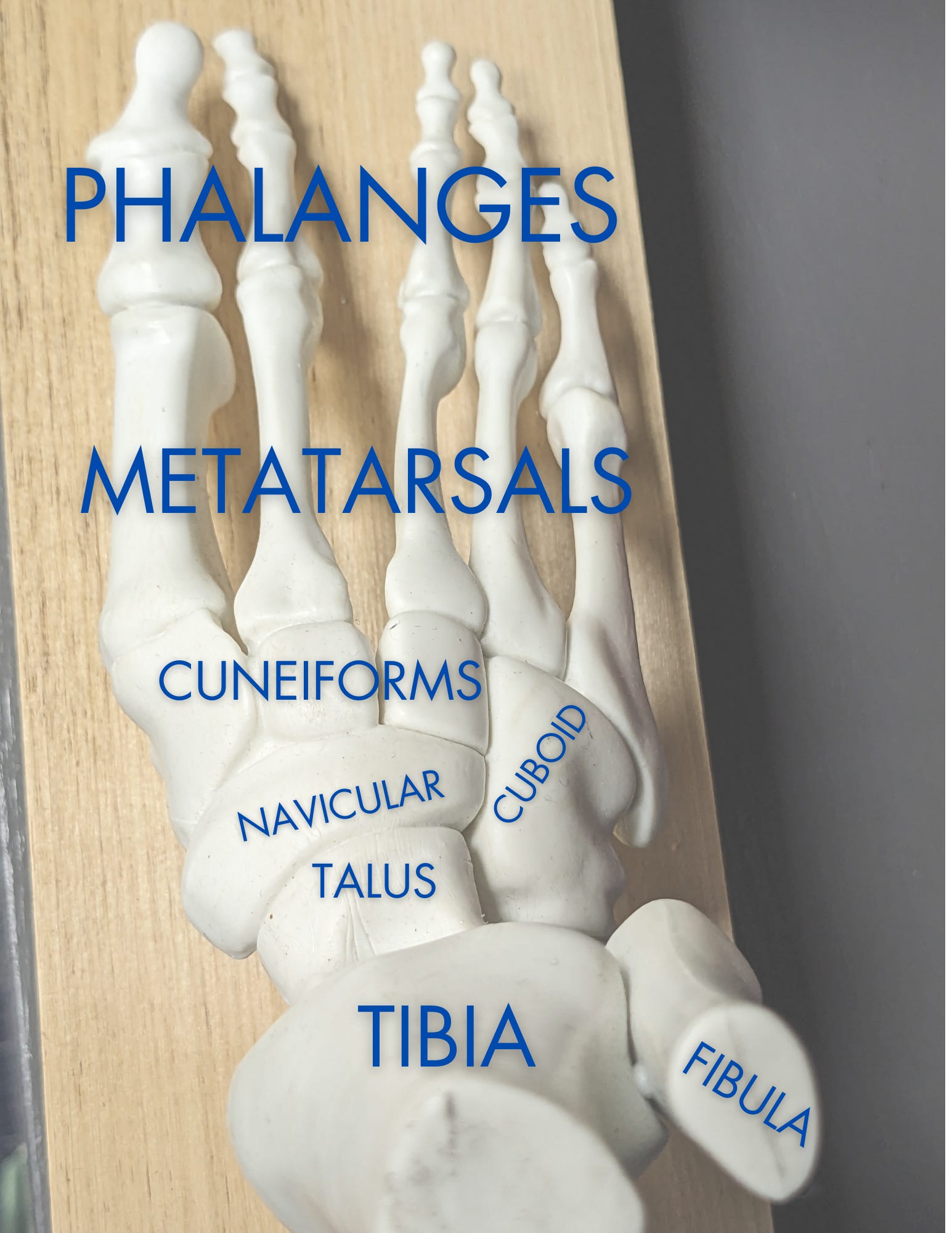
From this picture we can see most of the bones of the feet. Starting with the phalanges which are the toes, the metatarsals are the longer bones past the phalanges and then we get in to the cuneiforms. There are three of them the lateral, middle and medial. Just below that we have the navicular bone and the talus bone. The cuboid bone we find on the right side of this foot. The only bone you cannot see is the calcaneus or the heel bone as most of know it as. The arches are know as medial and lateral or inside or out side of the foot. To understand how the bones move we will need to look at some of the muscles that create the movement.
To make this section less of an anatomy class I will just give you some of the muscles that are the prime movers of the foot. Starting with the muscles that raise the foot off the ground (dorsiflexion). Tibialis anterior is the first muscle that comes to mind, this muscle can be found where the edge of your shin bone is. Some other foot raisers are extensor digitorum longus and extensor hallucis longus. These two muscle can be found in the same area but digitorum connects to toes 2-4 while hallucis attaches to the big toe. The muscles that we would use to push your foot into the ground (plantarflexion) are more numerous as we have gastrocnemius, soleus and tibialis posterior. The names are not important for you to remember but understanding the gastrocnemius and soleus muscles are know as the calf muscles could help. The plantaris muscle comes down from the back of the knee to the foot. Having some understanding of how our body works can make dealing with injuries more manageable.
The gastrocnemius crosses over the knee which connects it to the rest of the body. With knowing very little of the few muscle we do. This almost makes it clear how if we have an imbalances in the body it could throw off our knee, hip and shoulders. So just because you do not want to step back down on the part of your foot that received an injury from the Lego or other object you just stepped on does not mean you will not only feel it from your foot to your brain but you might start feeling it in your hip or other parts of your body. We often get compensation from the other side of our body having to pick up the slack of our injured side.
The next time you step on your child’s toy or other object you might say “ouch that really hurt my metatarsal bones” or the next time your shin hurts you might think my tibialis anterior sure is tight.